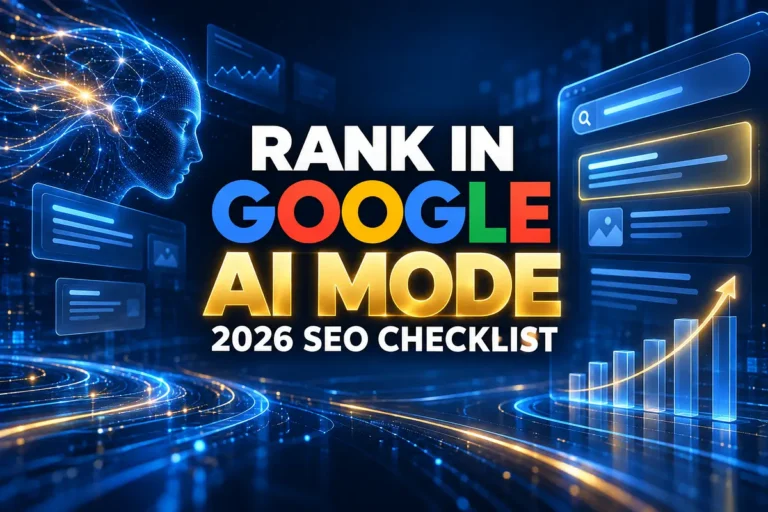
Most “AI Mode SEO” advice out there is just old SEO advice with “AI” pasted on top. That’s not going to cut it.
Google AI Mode doesn’t work like traditional search. However, It doesn’t just retrieve a ranked list of pages, it breaks your query into several hidden sub-questions, searches for each one separately, then stitches the answer together from whichever pages handle each piece best. Meanwhile, If you’re only optimizing for one keyword, you’re only fighting for one piece of a much bigger puzzle. We covered the broader shift in our guide to GEO vs SEO in 2026, this post is the tactical checklist for the AI Mode side of that shift specifically.
Here’s what actually moves the needle, based on how AI Mode is built and what’s showing up in 2026 citation data.
Why Ranking #1 on Google Isn’t Enough Anymore
This is the part that surprises most site owners: a large share of AI Overview citations now come from pages ranking below position #5, not the top spot. Therefore, AI Mode’s retrieval system pulls from passage quality and trust signals, not position alone.
That means your page can rank #8 and still get cited above the page sitting at #1, if your content answers the sub-question more directly and more completely.
The 2026 AI Mode Ranking Checklist:
Foundational Fixes:
1. Map your content to sub-questions, not just one keyword.
AI Mode decomposes every query into multiple hidden sub-queries and retrieves results for each in parallel. Thus, structure each page as one complete resource, broken into sections where every sub-question a buyer would actually ask gets its own H2.
2. Put the direct answer in the first 40 words under every H2.
Lead with the answer, then explain. Hence, this is exactly the format Gemini’s retrieval system prefers to lift and quote, burying the answer in paragraph three means it gets skipped.
3. Make every section “citation-ready” on its own.
Semantic completeness means a section should make sense with zero outside context and no extra click needed. Therefore, If a reader would need to scroll up to understand a paragraph, rewrite it so it stands alone.
4. Fix your Core Web Vitals as a set, not one at a time.
As of the March 2026 Core Update, Google now scores LCP, INP, and CLS together as one composite performance signal instead of grading them separately, meaning passing two out of three and failing the third now hurts you more than it used to. Since most AI Mode queries happen on mobile, test your mobile scores specifically.
5. Add Person schema to every author.
Pages with clearly authored content are cited noticeably more often on health, finance, legal, and similarly sensitive topics. Include jobTitle, worksFor, and a sameAs link to the author’s LinkedIn or professional profile.
Advanced Signals:
6. Build topical clusters, not standalone posts.
Entity authority compounds. A tight cluster of pages covering one topic in depth outperforms scattered one-off posts on adjacent topics, even if the one-off post is technically well-written. Nevertheless, If you haven’t already, this is a good moment to connect this post back to your related content on AI in marketing and digital marketing strategy in general.
7. Earn mentions in round-ups, guides, and comparison posts.
When multiple cited pages reference your domain elsewhere, AI Mode treats that as an authority signal. Paid placements and obvious link networks get filtered out, genuine mentions in industry content are what count.
8. Cite your own sources.
Content that references authoritative sources (studies, .gov, .edu, primary data) gets treated as more trustworthy by the retrieval layer. Don’t just assert a stat, link to where it came from.
9. Update old content instead of only publishing new content.
Freshness is one of the core ranking systems AI Overviews draw on. A refreshed, accurate post from two years ago can outperform a brand-new thin post, this is also a good reason to go back and update your older posts on things like losing customers through weak digital marketing, since stale numbers erode trust signals fast.
10. Track your AI citation share, not just your keyword rankings.
Start monitoring how often your brand actually shows up inside AI Mode and AI Overview answers for your target queries, not just where you rank in the ten blue links. Accordingly, this is becoming the visibility metric that matters most in 2026, and almost nobody is tracking it yet, which is exactly the opportunity in the title of this post.
What Hasn’t Changed
Query fan-out and citation-worthiness are new game mechanics, but they run on the same foundation as always: relevance, content quality, expertise, and genuine user value. Domain Authority alone carries less weight than it used to, and simply holding a page-one ranking is no longer a reliable path into the AI answer. Depth and trust now matter more than size.
FAQ
Do I need to rank #1 on Google to appear in AI Mode?
No. AI Mode frequently cites sources from well outside the top few positions, based on passage quality and how directly a section answers the specific sub-question being asked.
Does content length matter for AI Mode ranking?
Not directly. What matters is whether each section is a complete, self-contained answer. A well-structured 800-word page can out-cite a rambling 3,000-word page.
Is AI Mode the same as AI Overviews?
No. AI Overviews appear inside regular Google search results. AI Mode is a separate, more conversational search experience that runs on Google’s more powerful models and does deeper multi-step research per query.
How do I track if I’m being cited in AI Mode?
Manually test your target queries directly in AI Mode and note which domains get cited. Several SEO tools launched in 2026 now track AI citation share automatically, worth adopting if AI-driven queries are a meaningful part of your traffic.
For more on the shift from traditional rankings to AI visibility, read our full breakdown of GEO vs SEO in 2026, or browse more digital marketing strategies on our blog.
My Other Digital Marketing Blogs:
our guide to GEO vs SEO in 2026
related content on AI in marketing
losing customers through weak digital marketing
About the Author:
Nihla Hashim is a digital marketing strategist in Abu Dhabi, UAE, with 4 years of experience helping brands navigate SEO, paid ads, and Google Business Profile optimization. She specializes in social media marketing, Meta and Google ads, website development (WordPress and Shopify), branding, and AI-driven search visibility including GEO. She has worked with small businesses, B2B, B2C, and SaaS brands to grow their organic and AI search presence profitably.
Connect with Nihla on-
LinkedIn : www.linkedin.com/in/nihla-hashim-567296367
Instagram https://www.instagram.com/nihlahashimfb/
Facebook https://www.facebook.com/profile.php?id=61593833080247
or explore more of her writing on Blogs page: https://nihlahash.com/nihlahash-com-digital-marketing-blogs